
 Posted by
 “If there is one place on the face of earth where all the dreams of living men have found a home from the very earliest days when man began the dream of existence, it is India!” Romaine Rolland
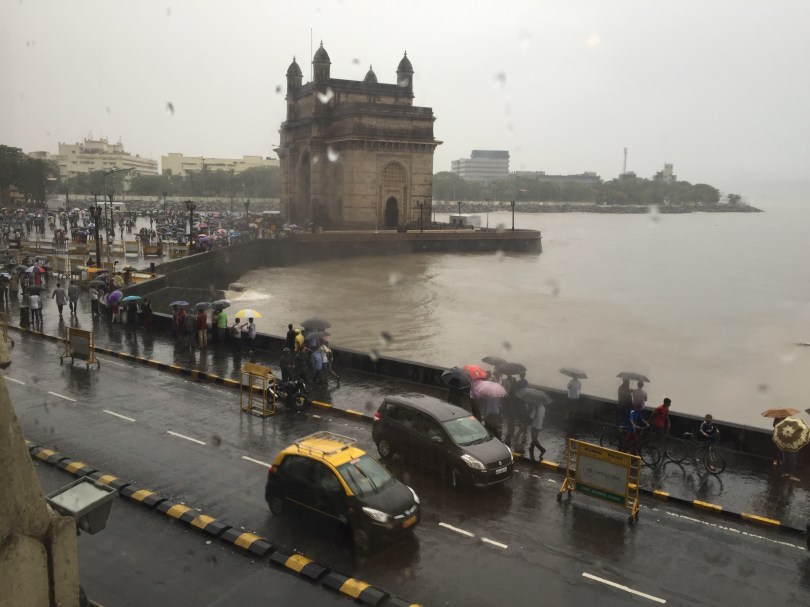
Unluckily for us, our final afternoon in Mumbai and our only opportunity to explore, coincided with the long awaited start of the monsoon rains.
While we sheltered in our car, all around us the locals were reveling in the rain, young boys, shirts off chasing each other, families strolling on the beach and general movement to and fro – many people not even bothering with umbrellas, enjoying the sensation of the torrential rain washing over them and enjoying the welcome relief from the sweltering heat that is a constant in this city. This year looks like it’s going to be a good monsoon, at last and the locals are delighted after 3 years of poor rains and the hardships that come with the lack of water….
Our guide Dada chattered away as we drove, pointing out notable temples and colonial era landmarks on all sides.
Mumbai is a city of around 18 million people and was known as Bombay, or beautiful bay, until 1995 when the locals renamed it Mumbai after the deity Mumbā Devi, the patron goddess of Maharashtra State. This was the first of the Indian cities to be renamed, finally throwing off a colonial past and centuries of foreign rule most recently by the Portuguese and British and lasting until India’s independence in 1947. A staggering 54% of the population of Mumbai live in the cities slums, but more on that next time…
Made up of 7 islands, the city was originally home to fishing communities and, being by the sea this remains an important activity in Mumbai today. However, the monsoon sparks the end of fishing for the season as the government bans boats on the harbor due to the treacherous conditions.
The rain stopped briefly as we approached Dhobi Ghat, an enormous open air laundry where the Dhobi’s, or washermen, wash the cities clothes in vast open air concrete tubs.


We were told that the Dhobi’s here all came from the same village in Northern India and live and work on site here for their whole lives… I hate to think how they manage to get anything dry during the monsoon which lasts for 3 months of the year.
Every Indian city has a museum dedicated to Ghandi and Mumbai’s, Mani Bhavan, was located in the house where he lived and launched many key political movements, including the non-cooperation movement between 1917 and 1934.
I loved the letter written by Ghandi to Hitler in 1939 – what a shame there are so few Ghandi’s and Mandela’s in the world.
“That I address you as a friend is no formality. I own no foes. My business in life has been for the past 33 years to enlist the friendship of the whole of humanity by befriending mankind, irrespective of race, colour or creed…”


During the afternoon we weren’t able to see much due to the chaos caused by the rains, but wanted at least to see the Gateway and visit the famous Taj Palace Hotel before heading back.
The Taj Palace has seen a lot in it’s 113 year history including the famous bombing in 2008 where 6 explosions destroyed the entire first floor of the hotel. Our delightful waiter Netson, who proudly told us he’d worked at the Taj for 30 + years, recounted how he had been working at the time and had hidden with 4 guests for several hours after the attack.
He told us how Jamsetji Tata built the Taj Palace after he was refused entry to one of the city’s grandest hotels of the time which was restricted to “whites only”. Whatever the motivation he succeeded in building a magnificent hotel that remains a focal point of the city to this day.
We indulged in the most wonderful high tea in the Sea Lounge overlooking the Gateway and a grey and uninviting sea, plied with more food than we could ever hope to eat by the wonderfully attentive Netson.


It had taken us only half an hour to get into town from our hotel by the airport and 2 and a half hours to get back due to the congestion caused by the rain and the Indian’s inability to follow road rules of any kind – a 3 lane highway can have as many as 7 cars abreast at any one time, all madly honking to ensure all the other drivers know they are there!
“Mr William, he said, in my life six times have I crashed, and on not one occasion have I ever been killed.” Bevinda Singh taxi driver from City of Djinns ~ William Dalrymple
I feel I’ve barely skimmed the surface of this wonderful city but I’ll be back very soon and can’t wait to spend time walking around and exploring -hopefully when the sun is shining 🙂
 throughmyeyes19com
This is very good. Didn’t know you could write this well. Quirky and curious detail and anecdote. Ghandi’s letter for instance is so sad. “I own no foes.”
Read the Arab street one too .. That was good too.
LikeLiked by 1 person